> ## Documentation Index
> Fetch the complete documentation index at: https://wb-21fd5541-codex-link-agent-evals-docs.mintlify.site/llms.txt
> Use this file to discover all available pages before exploring further.
# Add W&B to a Python library
> Best practices for integrating W&B into your Python library for experiment tracking, system monitoring, and model management.
This guide explains how to integrate W\&B into a Python library so that your users can track experiments, monitor system metrics, and manage models when they use your code. It's intended for library authors and maintainers who want to expose W\&B functionality through their own framework, SDK, or reusable training code.
Follow these recommendations if you're integrating W\&B into a complex codebase (such as a training framework, SDK, or reusable library) where the codebase is more involved than a single Python training script or Jupyter notebook.
If you're new to W\&B, review the core guides (for example, [Experiment Tracking](/models/track/)) before continuing.
The following sections walk through the major integration decisions in order: how to install W\&B, how to authenticate, how to start and configure runs, how to log metrics and artifacts, and how to support distributed training and hyperparameter sweeps.
## Decide how users install W\&B
Before you start, decide whether W\&B should be a required dependency or an optional feature of your library. This choice affects how you import the W\&B Python SDK (`wandb`), how you document installation, and how you handle environments where `wandb` isn't present.
### Require W\&B as a dependency
If W\&B is central to your library's functionality, add `wandb` to your dependencies so that it's installed automatically alongside your library:
```txt theme={null}
torch==1.8.0
...
wandb==0.13.*
```
### Make W\&B optional on installation
If W\&B is an optional feature, allow your library to run without it installed so that users who don't need experiment tracking can still use your code.
You can either import `wandb` conditionally in Python or declare it as an optional dependency in `pyproject.toml`.
Detect whether `wandb` is available and raise a clear error if a user enables W\&B features without installing it:
```python theme={null}
try:
import wandb
_WANDB_AVAILABLE = True
except ImportError:
_WANDB_AVAILABLE = False
```
Declare `wandb` as an optional dependency to your `pyproject.toml` file:
```toml theme={null}
[project]
name = "my_awesome_lib"
version = "0.1.0"
dependencies = [
"torch",
"sklearn"
]
[project.optional-dependencies]
dev = [
"wandb"
]
```
## Authenticate users
W\&B uses API keys to authenticate users and machines. Before users can log runs from your library, they must generate an API key and make it available to the `wandb` client.
### Create an API key
An API key authenticates a client or machine to W\&B. Generate an API key from your user profile so that you can use it for the login steps that follow.
For a more streamlined approach, go to [User Settings](https://wandb.ai/settings) and create an API key. Copy the API key immediately and save it in a secure location such as a password manager.
1. Click your user profile icon in the upper right corner.
2. Select **User Settings**, then scroll to the **API Keys** section.
### Install and log in to W\&B
After you have an API key, install the `wandb` library locally and log in so that subsequent runs can authenticate to W\&B. Choose the tab that matches your environment.
1. Set the `WANDB_API_KEY` [environment variable](/models/track/environment-variables/) to your API key. Replace values enclosed in `<>` with your own:
```bash theme={null}
export WANDB_API_KEY=
```
2. Install the `wandb` library and log in:
```bash theme={null}
pip install wandb
wandb login
```
1. Navigate to your terminal and install the Python SDK.
```bash theme={null}
pip install wandb
```
2. Log in to W\&B from your Python script or notebook. W\&B prompts you to enter
your API key.
```python theme={null}
import wandb
wandb.login()
```
Copy and paste the following code snippet into a cell in your Jupyter notebook and run it. W\&B prompts you to enter your API key.
```python theme={null}
!pip install wandb
import wandb
wandb.login()
```
## Start a run
After you set up authentication, the next step is to start a W\&B run so that your library has somewhere to log metrics, configs, and artifacts.
A *run* represents a single unit of computation, such as a training experiment. Most libraries create one run per training job. For more information about runs, see [W\&B Runs](/models/runs/).
Initialize a run with [`wandb.init()`](/models/ref/python/functions/init) and specify a name for your project and your team entity (team name). If you don't specify a project, W\&B stores your run in a default project called "uncategorized". Replace values enclosed in `<>` with your own:
```python theme={null}
with wandb.init(project="", entity="") as run:
...
```
W\&B recommends that you use a context manager to ensure that your run is properly closed, even if an error occurs. If you don't use a context manager, you must call `run.finish()` to close the run and log all the data to W\&B. Closing the run guarantees that all metrics, configs, and artifacts are uploaded before the process exits.
**When to call `wandb.init()`**
Call `wandb.init()` as early as possible. W\&B captures stdout, stderr, and error messages, which makes debugging easier.
Wrap your entire training loop in a `wandb.init()` context manager to ensure that all relevant information is captured in the run. This includes any error messages, which can be crucial for debugging.
### Set `wandb` as an optional dependency
If you want to make `wandb` optional at runtime, so that users can run your library without producing W\&B runs, use one of the following approaches:
* Define a `wandb` flag.
* Set `wandb` to be `disabled` in `wandb.init()`.
* Set `wandb` to be offline. This still runs `wandb`, but doesn't communicate back to W\&B over the internet.
Define a `wandb` flag such as:
```python theme={null}
trainer = my_trainer(..., use_wandb=True)
```
```bash theme={null}
python train.py ... --use-wandb
```
Set `wandb` to be `disabled` in `wandb.init()`:
```python theme={null}
wandb.init(mode="disabled")
```
```bash theme={null}
export WANDB_MODE=disabled
```
or
```bash theme={null}
wandb disabled
```
Set `wandb` to be offline:
```bash theme={null}
export WANDB_MODE=offline
```
or
```python theme={null}
os.environ['WANDB_MODE'] = 'offline'
```
```bash theme={null}
wandb offline
```
## Define a run config
After you initialize a run, you can attach a configuration dictionary that records the hyperparameters and other metadata associated with that run. Logging a config makes runs easier to compare, filter, and reproduce later.
Provide a configuration dictionary when you initialize your run to log hyperparameters and other metadata to W\&B.
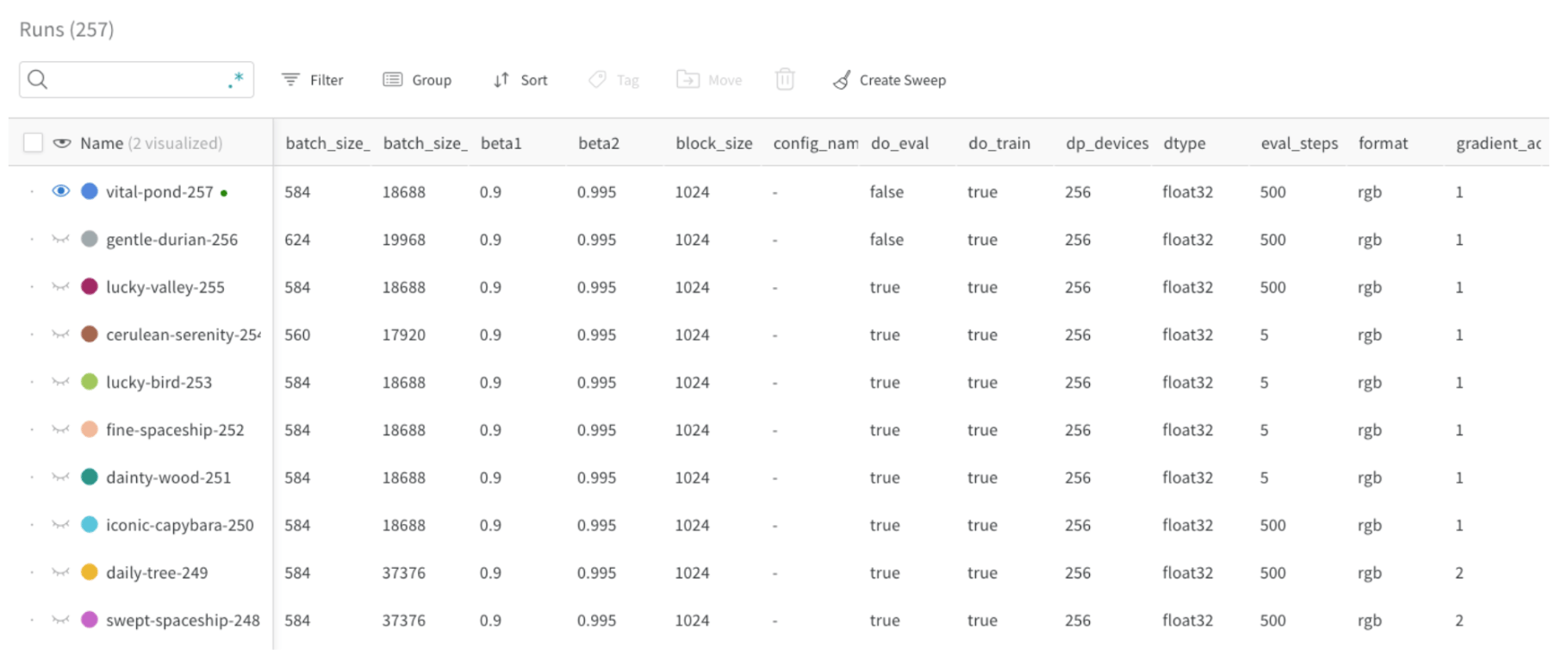
Use W\&B to compare runs based on their config parameters and filter them in the Runs table. You can also use these parameters to group runs together in W\&B.
For example, in the following image, the batch size (`batch_size`) is defined as a config parameter and is visible (see first column) in the Runs table. This lets users filter and compare runs based on their batch size:
 Typical config parameter values include:
* Model name, version, architecture parameters, and hyperparameters.
* Dataset name, version, number of training or validation examples.
* Training parameters such as learning rate, batch size, and optimizer.
The following code snippet shows how to log a config:
```python theme={null}
config = {"batch_size": 32, ...}
with wandb.init(..., config=config) as run:
...
```
### Update the run config
Some configuration values, such as model parameter counts, might not be known when you call `wandb.init()`. If values aren't available at initialization time, update the config later with `wandb.Run.config.update`. For example, you might want to add a model's parameters after you instantiate the model:
```python theme={null}
with wandb.init(...) as run:
model = MyModel(...)
run.config.update({"model_parameters": 3500})
```
For more information, see [Configure experiments](/models/track/config/).
## Log metrics and data
After you start and configure a run, you can begin logging metrics and other data so that W\&B records them against the run.
### Log metrics
To log scalar metrics such as loss or accuracy, create a dictionary where each key is the name of a metric. Pass this dictionary object to [`wandb.Run.log()`](/models/ref/python/experiments/run#method-run-log) to log it to W\&B:
```python theme={null}
NUM_EPOCHS = 10
for epoch in range(NUM_EPOCHS):
for input, ground_truth in data:
prediction = model(input)
loss = loss_fn(prediction, ground_truth)
metrics = { "loss": loss }
run.log(metrics)
```
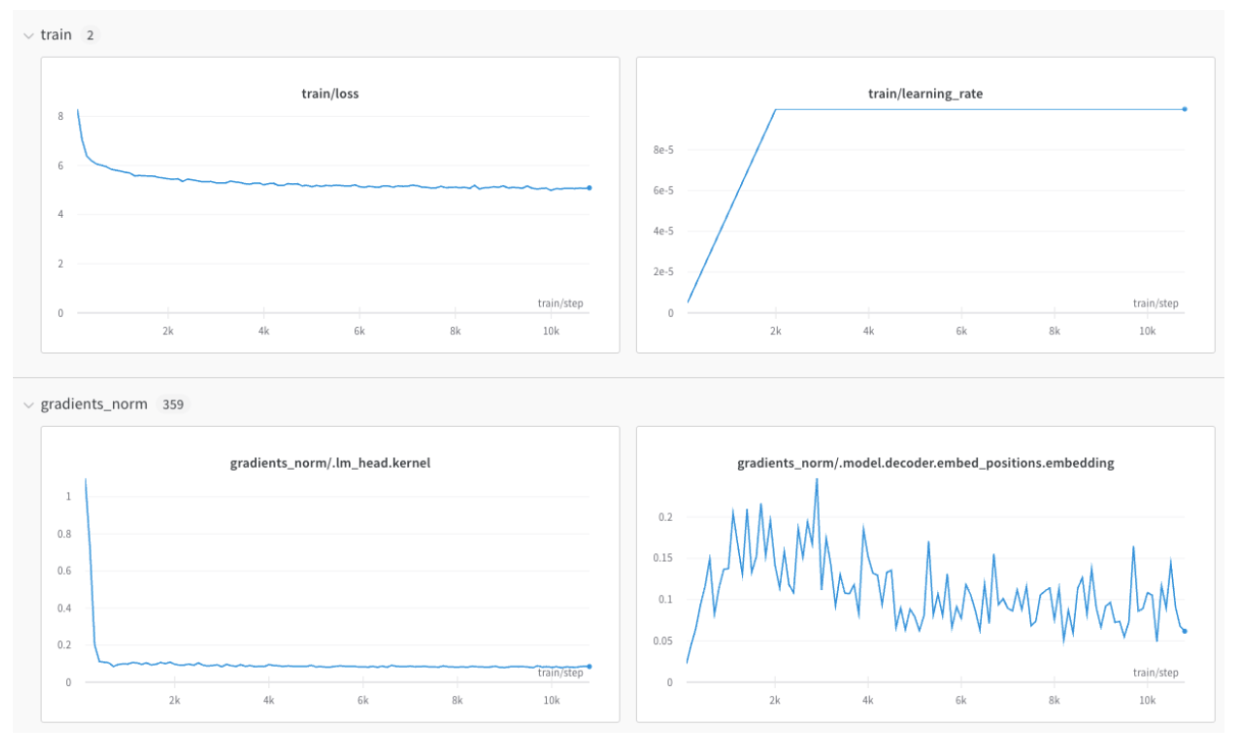
Use metric name prefixes to group related metrics in W\&B. Common prefixes include `train/` and `val/` for training and validation metrics, respectively, but you can use any prefix that makes sense for your use case.
This creates separate sections in your project's workspace for your training and validation metrics, or other metric types you'd like to separate:
```python theme={null}
with wandb.init(...) as run:
metrics = {
"train/loss": 0.4,
"train/learning_rate": 0.4,
"val/loss": 0.5,
"val/accuracy": 0.7
}
run.log(metrics)
```
Typical config parameter values include:
* Model name, version, architecture parameters, and hyperparameters.
* Dataset name, version, number of training or validation examples.
* Training parameters such as learning rate, batch size, and optimizer.
The following code snippet shows how to log a config:
```python theme={null}
config = {"batch_size": 32, ...}
with wandb.init(..., config=config) as run:
...
```
### Update the run config
Some configuration values, such as model parameter counts, might not be known when you call `wandb.init()`. If values aren't available at initialization time, update the config later with `wandb.Run.config.update`. For example, you might want to add a model's parameters after you instantiate the model:
```python theme={null}
with wandb.init(...) as run:
model = MyModel(...)
run.config.update({"model_parameters": 3500})
```
For more information, see [Configure experiments](/models/track/config/).
## Log metrics and data
After you start and configure a run, you can begin logging metrics and other data so that W\&B records them against the run.
### Log metrics
To log scalar metrics such as loss or accuracy, create a dictionary where each key is the name of a metric. Pass this dictionary object to [`wandb.Run.log()`](/models/ref/python/experiments/run#method-run-log) to log it to W\&B:
```python theme={null}
NUM_EPOCHS = 10
for epoch in range(NUM_EPOCHS):
for input, ground_truth in data:
prediction = model(input)
loss = loss_fn(prediction, ground_truth)
metrics = { "loss": loss }
run.log(metrics)
```
Use metric name prefixes to group related metrics in W\&B. Common prefixes include `train/` and `val/` for training and validation metrics, respectively, but you can use any prefix that makes sense for your use case.
This creates separate sections in your project's workspace for your training and validation metrics, or other metric types you'd like to separate:
```python theme={null}
with wandb.init(...) as run:
metrics = {
"train/loss": 0.4,
"train/learning_rate": 0.4,
"val/loss": 0.5,
"val/accuracy": 0.7
}
run.log(metrics)
```
 For more information, see [`wandb.Run.log()`](/models/ref/python/experiments/run#method-run-log).
### Control the x-axis
By default, the W\&B Python SDK manages its own step counter, which might not match the step semantics of your training loop. If you perform multiple calls to `wandb.Run.log()` for the same training step, the `wandb` SDK increments an internal step counter for each call to `wandb.Run.log()`. This counter might not align with the training step in your training loop.
To avoid this situation, define your x-axis step explicitly with `wandb.Run.define_metric()`, one time, immediately after you call `wandb.init()`:
```python theme={null}
with wandb.init(...) as run:
run.define_metric("*", step_metric="global_step")
```
The glob pattern, `*`, means that every metric uses `global_step` as the x-axis in your charts. If you only want certain metrics logged against `global_step`, you can specify them instead:
```python theme={null}
run.define_metric("train/loss", step_metric="global_step")
```
Now, log your metrics, your `step` metric, and your `global_step` each time you call `wandb.Run.log()`:
```python theme={null}
for step, (input, ground_truth) in enumerate(data):
...
run.log({"global_step": step, "train/loss": 0.1})
run.log({"global_step": step, "eval/loss": 0.2})
```
If you don't have access to the independent step variable (for example, `global_step` isn't available during your validation loop), W\&B automatically uses the previously logged value for `global_step`. In this case, ensure you log an initial value for the metric so that it's defined when it's needed.
### Log media and structured data
In addition to scalars, you can log images, tables, text, audio, video, and more. Logging media alongside metrics helps users inspect qualitative model behavior over time.
Some considerations when logging data include:
* How often should the metric be logged? Should it be optional?
* What type of data could be helpful in visualizing?
* For images, you can log sample predictions and segmentation masks to see the evolution over time.
* For text, you can log tables of sample predictions for later exploration.
For more information, see [Log objects and media](/models/track/log).
## Support distributed training
If your library can run training across multiple processes or machines, decide how W\&B should behave in that setting so that logs are coherent and not duplicated. For frameworks that support distributed environments, you can adapt any of the following workflows:
* Log only from the main process (recommended).
* Log from every process and group runs using a shared `group` name.
For more information, see [Log distributed training experiments](/models/track/log/distributed-training/).
## Track models and datasets with artifacts
In addition to metrics, you can persist the models and datasets your library produces or consumes so that users can reproduce and compare runs.
Use [W\&B Artifacts](/models/artifacts/) to track and version models and datasets. Artifacts provide storage and versioning for machine learning assets, and they automatically track lineage to show how data and models are related.
For more information, see [`wandb.Run.log()`](/models/ref/python/experiments/run#method-run-log).
### Control the x-axis
By default, the W\&B Python SDK manages its own step counter, which might not match the step semantics of your training loop. If you perform multiple calls to `wandb.Run.log()` for the same training step, the `wandb` SDK increments an internal step counter for each call to `wandb.Run.log()`. This counter might not align with the training step in your training loop.
To avoid this situation, define your x-axis step explicitly with `wandb.Run.define_metric()`, one time, immediately after you call `wandb.init()`:
```python theme={null}
with wandb.init(...) as run:
run.define_metric("*", step_metric="global_step")
```
The glob pattern, `*`, means that every metric uses `global_step` as the x-axis in your charts. If you only want certain metrics logged against `global_step`, you can specify them instead:
```python theme={null}
run.define_metric("train/loss", step_metric="global_step")
```
Now, log your metrics, your `step` metric, and your `global_step` each time you call `wandb.Run.log()`:
```python theme={null}
for step, (input, ground_truth) in enumerate(data):
...
run.log({"global_step": step, "train/loss": 0.1})
run.log({"global_step": step, "eval/loss": 0.2})
```
If you don't have access to the independent step variable (for example, `global_step` isn't available during your validation loop), W\&B automatically uses the previously logged value for `global_step`. In this case, ensure you log an initial value for the metric so that it's defined when it's needed.
### Log media and structured data
In addition to scalars, you can log images, tables, text, audio, video, and more. Logging media alongside metrics helps users inspect qualitative model behavior over time.
Some considerations when logging data include:
* How often should the metric be logged? Should it be optional?
* What type of data could be helpful in visualizing?
* For images, you can log sample predictions and segmentation masks to see the evolution over time.
* For text, you can log tables of sample predictions for later exploration.
For more information, see [Log objects and media](/models/track/log).
## Support distributed training
If your library can run training across multiple processes or machines, decide how W\&B should behave in that setting so that logs are coherent and not duplicated. For frameworks that support distributed environments, you can adapt any of the following workflows:
* Log only from the main process (recommended).
* Log from every process and group runs using a shared `group` name.
For more information, see [Log distributed training experiments](/models/track/log/distributed-training/).
## Track models and datasets with artifacts
In addition to metrics, you can persist the models and datasets your library produces or consumes so that users can reproduce and compare runs.
Use [W\&B Artifacts](/models/artifacts/) to track and version models and datasets. Artifacts provide storage and versioning for machine learning assets, and they automatically track lineage to show how data and models are related.
 Consider the following when integrating artifacts into your library:
* Whether to log model checkpoints or datasets as artifacts (in case you want to make it optional).
* Artifact input references (for example, `entity/project/artifact`).
* Logging frequency of model checkpoints or datasets. For example, every epoch or every 500 steps.
### Log model checkpoints
Logging model checkpoints as artifacts lets users recover, version, and share trained weights. A common approach is to log checkpoints as artifacts using the unique run ID that W\&B generates as part of the artifact name.
```python theme={null}
metadata = {"eval/accuracy": 0.8, "train/steps": 800}
artifact = wandb.Artifact(
name=f"model-{run.id}",
metadata=metadata,
type="model"
)
artifact.add_dir("output_model") # local directory where the model weights are stored
aliases = ["best", "epoch_10"]
run.log_artifact(artifact, aliases=aliases)
```
The previous snippet logs a model checkpoint as an artifact with metadata such as evaluation accuracy and training steps. The artifact's name includes the unique run ID, and it's tagged with [custom aliases](/models/artifacts/create-a-custom-alias/) for quick reference.
### Log input artifacts
To capture lineage between data and models, log the datasets or pretrained models that a run consumes as inputs:
```python theme={null}
dataset = wandb.Artifact(name="flowers", type="dataset")
dataset.add_file("flowers.npy")
run.use_artifact(dataset)
```
The previous snippet creates an artifact for a dataset called "flowers" and adds a file to it. The `wandb.Run.use_artifact()` call associates the artifact with the current run so that W\&B can track the lineage of the dataset used in the run.
### Download artifacts
After you log artifacts, you can download previously logged artifacts from W\&B to use in training or inference code. The right approach depends on whether you already have an active run.
If you have a run context, use [`wandb.Run.use_artifact()`](/models/ref/python/experiments/run) to reference an artifact in W\&B and then call [`wandb.Artifact.download()`](/models/ref/python/experiments/artifact) to download it to a local directory. Using `wandb.Run.use_artifact()` also records the artifact as an input to the current run, preserving lineage.
```python theme={null}
with wandb.init(...) as run:
artifact = run.use_artifact("user/project/artifact:latest")
local_path = artifact.download()
```
Use the [W\&B Public API](/models/ref/python/public-api/) to reference and download an artifact without initializing a run. This is useful in scenarios such as distributed environments or when you perform inference, where you might not want to create a new run.
```python theme={null}
import wandb
artifact = wandb.Api().artifact("user/project/artifact:latest")
local_path = artifact.download()
```
For more information, see [Download and use artifacts](/models/artifacts/download-and-use-an-artifact/).
## Tune hyperparameters
If your library supports hyperparameter tuning, you can integrate [W\&B Sweeps](/models/sweeps/) to manage and visualize experiments. Sweeps coordinate multiple runs across a defined search space and surface the results in W\&B so users can compare configurations side by side.
Consider the following when integrating artifacts into your library:
* Whether to log model checkpoints or datasets as artifacts (in case you want to make it optional).
* Artifact input references (for example, `entity/project/artifact`).
* Logging frequency of model checkpoints or datasets. For example, every epoch or every 500 steps.
### Log model checkpoints
Logging model checkpoints as artifacts lets users recover, version, and share trained weights. A common approach is to log checkpoints as artifacts using the unique run ID that W\&B generates as part of the artifact name.
```python theme={null}
metadata = {"eval/accuracy": 0.8, "train/steps": 800}
artifact = wandb.Artifact(
name=f"model-{run.id}",
metadata=metadata,
type="model"
)
artifact.add_dir("output_model") # local directory where the model weights are stored
aliases = ["best", "epoch_10"]
run.log_artifact(artifact, aliases=aliases)
```
The previous snippet logs a model checkpoint as an artifact with metadata such as evaluation accuracy and training steps. The artifact's name includes the unique run ID, and it's tagged with [custom aliases](/models/artifacts/create-a-custom-alias/) for quick reference.
### Log input artifacts
To capture lineage between data and models, log the datasets or pretrained models that a run consumes as inputs:
```python theme={null}
dataset = wandb.Artifact(name="flowers", type="dataset")
dataset.add_file("flowers.npy")
run.use_artifact(dataset)
```
The previous snippet creates an artifact for a dataset called "flowers" and adds a file to it. The `wandb.Run.use_artifact()` call associates the artifact with the current run so that W\&B can track the lineage of the dataset used in the run.
### Download artifacts
After you log artifacts, you can download previously logged artifacts from W\&B to use in training or inference code. The right approach depends on whether you already have an active run.
If you have a run context, use [`wandb.Run.use_artifact()`](/models/ref/python/experiments/run) to reference an artifact in W\&B and then call [`wandb.Artifact.download()`](/models/ref/python/experiments/artifact) to download it to a local directory. Using `wandb.Run.use_artifact()` also records the artifact as an input to the current run, preserving lineage.
```python theme={null}
with wandb.init(...) as run:
artifact = run.use_artifact("user/project/artifact:latest")
local_path = artifact.download()
```
Use the [W\&B Public API](/models/ref/python/public-api/) to reference and download an artifact without initializing a run. This is useful in scenarios such as distributed environments or when you perform inference, where you might not want to create a new run.
```python theme={null}
import wandb
artifact = wandb.Api().artifact("user/project/artifact:latest")
local_path = artifact.download()
```
For more information, see [Download and use artifacts](/models/artifacts/download-and-use-an-artifact/).
## Tune hyperparameters
If your library supports hyperparameter tuning, you can integrate [W\&B Sweeps](/models/sweeps/) to manage and visualize experiments. Sweeps coordinate multiple runs across a defined search space and surface the results in W\&B so users can compare configurations side by side.